Rose Flowers Graphics for Canva & Creative Projects
First Impression: Romantic, Handcrafted, and Farm-Fresh
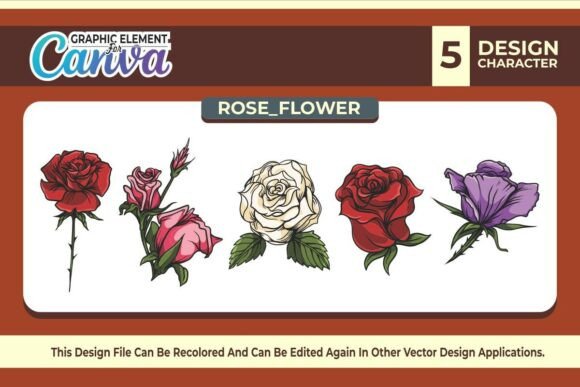
Opening the Rose Flowers Graphic Element Vector Set, I immediately felt its warmth—soft petal curves, subtle stem textures, and a gentle botanical rhythm that avoids stiff symmetry. These aren’t clinical botanical diagrams or over-polished stock illustrations. They’re five distinct rose characters: a blooming centerpiece, a side-facing bud, a trailing vine, a clustered bouquet, and a single stem with dewy leaves. Each carries quiet personality—slightly imperfect, organically spaced, with delicate line weight variation. It reads as *hand-drawn then digitized*, not AI-generated or mass-produced clipart. For a client launching a small-batch lavender soap line with farmhouse packaging and Instagram storytelling, this set landed like a quiet “yes”—evoking authenticity, care, and seasonal charm without tipping into cliché.
Where It Shines in Real Client Work
This graphic design asset excels where emotional resonance matters more than stark minimalism. In packaging design, it anchors product labels beautifully—especially on kraft paper or cream cardstock—adding visual richness without overwhelming. On a product mockup for artisanal honey jars, the trailing vine version wraps elegantly around the label’s edge, reinforcing the “farm-to-jar” narrative. As social media graphics, the full bloom works powerfully in Pinterest pins and Instagram carousels—its detail holds up even when cropped tightly. For printable design like wedding invitations or seasonal planners, the SVG and PDF files scale flawlessly to 24" wide posters or 3" sticker sheets. And yes—it integrates cleanly into Canva templates: drop any vector into a Canva layout, ungroup, recolor in seconds, and layer behind hand-lettered headlines or over soft photo backgrounds.
- T-shirt design and sticker design: The clean outlines and intentional negative space make it ideal for screen printing and vinyl cutting.
- Cricut project users will appreciate how each element separates cleanly—no hidden layers or raster artifacts.
- Brand identity systems benefit from its versatility: use the bud as a subtle watermark, the bouquet as a hero banner, and the vine as a divider in editorial design or web design layouts.
- Print-on-demand sellers can confidently apply it to mugs, tote bags, and wall art—the high-resolution PNGs render crisply at 300 DPI, and the SVG ensures infinite scalability for sublimation design.
Use With Intention—Not Everywhere
This isn’t a universal fix. Its romantic, textured quality means it should be used carefully in contexts demanding sharp neutrality. Avoid it in logo design for tech startups or financial services—it lacks the precision and timelessness those brands require. Don’t force it into minimalist branding where whitespace and restraint define the voice. It also risks visual noise in crowded layouts—say, a busy festival flyer with 12 fonts and 5 competing icons. And while it’s lovely on light backgrounds, test it rigorously on dark ones: some stems fade if contrast isn’t adjusted manually. Likewise, avoid tiny applications (under 0.5") unless you’ve verified the fine lines remain legible in print—those delicate thorn details vanish at thumbnail size.
Design Judgment in Action: What I Tested Before Approving for My Client
Before locking it into the final brand kit, I ran practical checks:
- Black-and-white test: Printed grayscale versions—confirmed strong silhouette recognition and no muddy midtones.
- Background contrast: Placed all five elements over light cream, charcoal gray, and pale sage—adjusted stroke weights slightly for the dark background version.
- Scale verification: Previewed at 200% and 15%—the SVG stayed crisp; the PNG held detail down to 1.2" width.
- Font pairing: Tried serif (Playfair Display), sans serif (Montserrat), script (Dancing Script), and handwritten (Caveat)—it harmonized best with serif and soft script, adding elegance without competition.
- Licensing check: Confirmed commercial license covers client deliverables—including their Etsy product listings and Shopify store banners. No attribution required, but I noted the source for internal asset tracking.
Why It Strengthens Visual Trust & Audience Connection
For a handmade business, every visual cue signals values. This design bundle subtly communicates craftsmanship—not through perfection, but through considered imperfection: slight asymmetry in petals, organic stem bends, gentle tapering lines. That builds visual trust. When paired with warm-toned photography and thoughtful typography, it elevates marketing visuals from “cute” to “cohesive.” Clients notice the difference: one boutique owner told me her email open rate increased after switching to newsletters featuring these roses instead of generic floral clipart. Why? Because it feels *intentional*, not decorative filler. It supports brand consistency across touchpoints—from a Cricut-cut sticker on a shipping box to a hero graphic on their About page—without repeating the same image robotically.
A Final Note for Designers & Digital Sellers
If you're sourcing assets for client work, remember: great creative design starts with smart selection—not just aesthetics, but adaptability, technical integrity, and licensing clarity. The Rose Flowers Graphic Element Vector Set delivers on all three. Its 5 Vector Character Editable High Resolution SVG, PDF, PNG structure gives real flexibility—not just “vector” in name only. You can recolor, resize, isolate parts, and integrate into complex compositions without degradation. For designers building digital product suites, printable design collections, or commercial design kits, this is a quietly powerful addition to your library. Just remember: let it breathe. Give it room to speak. And always—always—test it in context before hitting export.