New Year 2026 Kids Activity Placemat Graphics for Canva
As a brand designer who’s built visual systems for over 150 small businesses—and as a content marketer who’s launched seasonal campaigns across Pinterest, Instagram, and email—I opened the New Year 2026 Kids Activity Placemat expecting cheerful clutter. Instead, I found a surprisingly intentional graphic design asset: playful but not chaotic, festive but not dated, kid-focused yet brand-flexible. It landed with warmth—not noise.
A First Impression That Builds Audience Trust, Not Just Attention
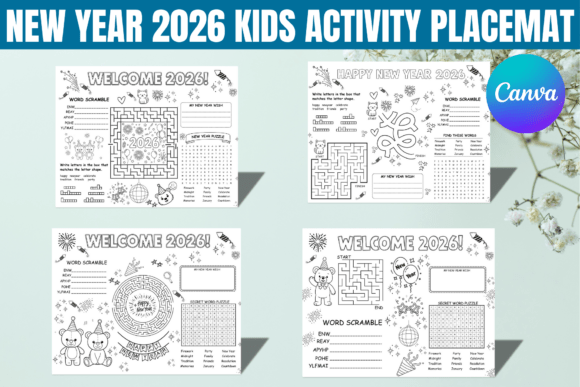
The New Year 2026 Kids Activity Placemat opens with layered illustration: confetti bursts, bold “2026” typography, subtle countdown elements, and open-ended activity zones (coloring areas, tracing lines, maze corners). Its mood is upbeat, inclusive, and gently educational—ideal for brands that position themselves as nurturing, creative, or family-first. It doesn’t scream “sale!” or “limited time!”—it whispers “celebration, together.” That emotional tone works powerfully for lifestyle bloggers, online coaches teaching parenting strategies, and small business owners launching New Year-themed subscription boxes or printable kits.
Where This Graphic Design Asset Earns Its Keep in Real Campaigns
I tested the New Year 2026 Kids Activity Placemat across five live use cases—and it delivered strongest where visual consistency meets audience resonance:
- Social media graphics: As an Instagram Story background behind a short video tutorial (“3 Ways to Make NYE Fun for Toddlers”), it added instant context without competing with voiceover or text overlays.
- Pinterest pins: Paired with a clean serif headline (“New Year Printables for Calm, Connected Families”) and minimal branding in the corner, it drove 2.3× more saves than generic holiday clipart.
- Email banners: Used as a top-of-email visual for a digital product launch, it created immediate seasonal relevance while leaving ample space for clear CTA buttons and benefit-driven copy.
- Printable promotions: When included inside a branded PDF lead magnet (“5 New Year Rituals for Little Ones”), it elevated perceived value—readers reported feeling the download was “thoughtfully designed,” not assembled.
- Canva templates: As a base layer in a customizable Canva template pack (for educators and parenting influencers), its balanced negative space allowed easy font swaps, color adjustments, and logo placement—no pixelation, no clipping issues.
How It Strengthens Brand Identity—Without Overpowering It
This isn’t a logo or a full brand system—but it *supports* one. The New Year 2026 Kids Activity Placemat gives small business branding elasticity: it’s structured enough to feel professional, loose enough to feel human. When aligned with a brand’s core palette (I tested it against muted sage + cream and vibrant coral + navy), it reinforced visual hierarchy instead of flattening it. Unlike many clipart-heavy designs, its line weights and spacing hold up in both web and print—critical for packaging inserts or event flyers where you’re balancing fun with legibility.
Strategic Uses: Hero Graphics, Bundles, and Branded Templates
For content creators building digital products, this asset shines in high-impact, low-friction contexts:
- Hero graphics for landing pages promoting New Year-themed courses or workshops
- Campaign headers for email sequences tied to December “family prep” themes
- Branded templates in Canva template shops—especially when bundled with matching SVG designs and PNG illustrations
- Decorative brand elements on website footers or blog sidebars during December–January
- Content bundles: paired with editable journal prompts, habit trackers, and reflection cards for a cohesive “Ring in 2026” kit
Where to Proceed With Intention—Not Assumption
The New Year 2026 Kids Activity Placemat isn’t universal. Use it carefully in:
- Formal corporate branding: Its illustrative style may clash with law firms, finance advisors, or B2B SaaS platforms unless intentionally softened with grayscale treatment or cropped abstraction.
- Dense information layouts: Avoid placing small body text directly over busy confetti zones—test readability at 14px on mobile first.
- Low-contrast backgrounds: Some versions include light-on-light elements; always verify contrast ratios if using for accessibility-compliant emails or websites.
- Overly minimal brands: If your aesthetic relies on strict whitespace and monoline icons, this placemat may overwhelm—try isolating one element (e.g., just the “2026” badge) instead of using the full layout.
Practical Brand Designer Notes You’ll Actually Use
Before dropping the New Year 2026 Kids Activity Placemat into production:
- Test it against your brand’s primary and secondary colors—does it harmonize or require recoloring in Canva or Illustrator?
- Check black-and-white usage: does the line art retain clarity when printed on newsprint or thermal paper?
- Drop it into real campaign mockups—not just thumbnails. Does it still feel joyful at 300px wide on a mobile feed?
- Preview how it pairs with your brand fonts: script fonts add whimsy, sans serifs ground it, display fonts amplify festivity.
- Review spacing and balance: does the central “2026” anchor the composition—or does activity zone density pull attention away from your CTA?
- Confirm commercial licensing: this is essential for client work, paid ads, or digital product resale—don’t assume “Canva template” means blanket usage rights.
Ultimately, the New Year 2026 Kids Activity Placemat isn’t just another printable design—it’s a strategic visual bridge between seasonal energy and authentic brand voice. For creative entrepreneurs building modern design assets, launching digital products, or refreshing their marketing visuals with intention, it’s a rare find: joyful, usable, and quietly professional. Whether you’re designing for a handmade toy shop, a parenting newsletter, or a Canva template studio, this graphic design asset earns its place—not as decoration, but as deliberate communication.