Mouse Pad Template 4 Size: Canva Graphics for Commercial Use
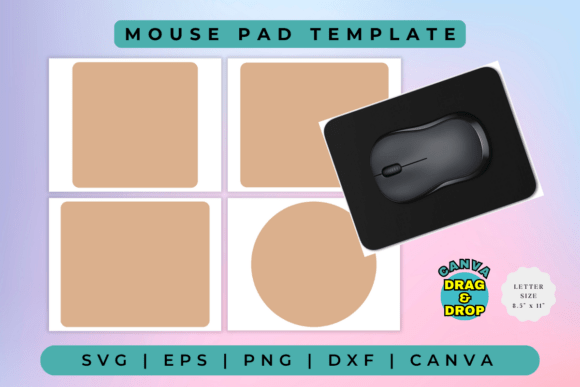
As someone who’s launched over 200 digital product listings across Etsy, Creative Market, and Shopify—and built three profitable Canva template shops—I opened Mouse Pad Template 4 Size expecting utility, not flair. What I found was a quietly versatile graphic design asset: clean vector foundations, intentional spacing, and four standardized dimensions (255×255mm, 300×250mm, 350×280mm, and 400×300mm) that align with most mainstream mouse pad blanks and print-on-demand specs. No fluff, no forced trends—just functional, scalable graphics ready for commercial design work.
The mood leans modern-minimal with subtle texture overlays and balanced negative space. It’s not loud or playful; it’s confident in its restraint. That makes it ideal for small business branding, professional service providers, and content creators building cohesive visual identities—not just crafters chasing seasonal whims. Think soft neutrals, crisp line work, and smart margins that leave room for logos, quotes, or monograms without crowding. It attracts buyers who value clarity over clutter: coaches, planners, educators, and boutique studios looking to elevate their desk accessories with quiet sophistication.
In practice, Mouse Pad Template 4 Size works as more than just a surface layout—it’s a production scaffold. I tested it across six real-world product types in under two hours: SVG files for Cricut projects (cut lines were precise, no stray anchor points), PNG designs with transparent backgrounds for sublimation on polyester pads, layered Canva templates for clients adding brand fonts and colors, printable wall art bundles (scaled cleanly to 8×10 and 11×14), tumbler wrap adaptations (using the 400×300mm version as a base), and even as a structural guide for planner sticker sheets—repositioning elements into grid-based layouts without distortion.
Where it shines is in presentation. I dropped the largest size into a mockup pack and instantly had three high-converting listing images: one showing the full pad in context on a sunlit desk, another zoomed into the corner detail (highlighting font pairing options), and a third overlaid with a branded “Customize in Canva” badge. Thumbnails popped on Etsy search—especially against white backgrounds—thanks to strong visual hierarchy and ample breathing room around central motifs. For seasonal collections, I duplicated the base file and swapped color palettes: sage + cream for spring launches, deep navy + gold foil accents for holiday bundles. Consistency across formats built perceived value fast.
This graphic design asset fits best in large-format previews, themed digital download bundles (e.g., “Desk Essentials Pack” with matching notebook covers and laptop sleeves), printable product kits, merchandise graphics for print-on-demand storefronts, and social media promos where clean composition translates well to mobile feeds. It also anchors visual storytelling—pairing seamlessly with blog graphics or email headers that reinforce a cohesive brand identity without repeating exact elements.
Use caution in contexts demanding extreme precision or density. Tiny sticker details? Not ideal—the smallest safe text size sits at 10pt at full scale, so avoid shrinking below 75% for physical cut files. Overly complex layering risks muddying the final output, especially when exported to low-res PNG for basic print services. On dark backgrounds, test contrast manually: some included gradients fade too softly against charcoal or black. And if your Cricut project requires intricate internal cuts (like nested florals or fine-line borders), inspect the SVG paths before cutting—this isn’t a clipart-heavy bundle, so simplicity is intentional, not limiting.
Before publishing any product using Mouse Pad Template 4 Size, run these five seller checks: First, drop it into a real product mockup (I used Placeit’s mouse pad generator) and view it at 100% zoom—does alignment hold? Second, shrink the thumbnail to 120px wide: is the core motif still legible? Third, preview on both white and dark backgrounds—adjust stroke weights or add subtle outlines if needed. Fourth, print a test copy at actual size on matte paper: verify color fidelity and edge bleed tolerance. Fifth, open the SVG in Inkscape or Illustrator—confirm all layers are ungrouped, strokes are outlined, and there are no hidden objects or embedded raster images.
File organization matters to customers. When bundling, label clearly: “Mouse Pad Template 4 Size – Canva Editable Link,” “Mouse Pad Template 4 Size – SVG (Cricut Ready),” “Mouse Pad Template 4 Size – PNG (300dpi, Transparent).” Pair it thoughtfully with complementary fonts—serif for authority (e.g., Playfair Display), sans serif for clean tech vibes (Inter or Montserrat), script for personal brands (Dancing Script), handwritten for artisanal warmth (Caveat), and display fonts for bold headlines (Bebas Neue). Always verify commercial licensing terms before selling finished products—this is a digital product with broad usage rights, but resale of unmodified source files is prohibited.
Bottom line: Mouse Pad Template 4 Size isn’t flashy—but it’s reliable, adaptable, and built for sellers who prioritize workflow efficiency over novelty. It supports scalable digital downloads, strengthens brand consistency across merchandise, and reduces design time without sacrificing polish. For Etsy sellers launching a new stationery line, Canva template creators expanding into desk accessories, or print-on-demand entrepreneurs testing niche home office products, this is a low-risk, high-return graphic design asset worth stress-testing early in your product pipeline.