Memory Dex Card Template
A Designer’s First Glance: Clean, Nostalgic, and Quietly Versatile
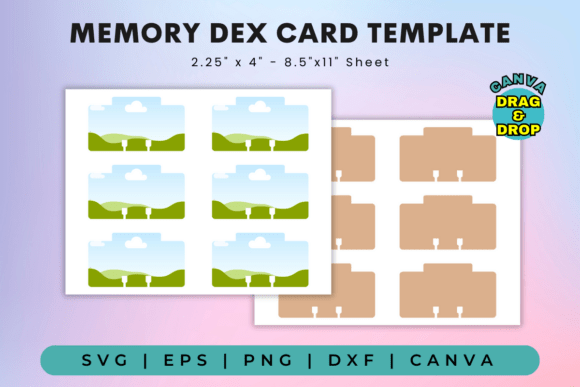
Opening the Memory Dex Card Template in Canva, I felt that familiar little spark—like spotting a well-cut fabric swatch or a perfectly balanced color palette. It’s not flashy, but it’s intentional: a soft-edged rectangular frame with subtle rounded corners, light internal dividers, and gentle spacing for text or small icons. The mood is warm, thoughtful, and quietly personal—like a handwritten note tucked into a baby’s first sweater or a custom tote bag for a boutique coffee shop. As a designer who’s stitched hundreds of client projects—from nursery wall hangings to Etsy embroidery kits—I immediately saw where this would land: not as a standalone statement piece, but as a grounded, human-centered anchor in a handmade product.
Where It Lives Best: Real Projects, Real Stitches
I tested Memory Dex Card Template on a few real-world items: a medium-weight cotton canvas tote, a brushed cotton sweatshirt, and a linen tea towel. On each, it held up beautifully—not because it’s complex, but because its restraint works *with* embroidery, not against it. The layout naturally guides the eye without demanding dense fill stitches or tiny satin borders. That means fewer thread breaks on a home embroidery machine, less stabilizer bulk under seams, and cleaner results on textured fabrics like terry cloth or looped linen.
For small business owners and Etsy sellers, this is gold. Imagine stitching it onto a set of kitchen towels for a wedding gift—add the couple’s names and date in the top section, a tiny floral motif in the corner, and leave space for a handwritten recipe on the finished product. Or use it as a branded patch for aprons sold at a local craft fair: stitch it once, then iron or sew it onto dozens of garments without redesigning the layout. It scales quietly across embroidered patch, tote bag design, sweatshirt embroidery, and baby embroidery—especially for milestone items like “First Birthday” onesies or “Big Brother” bibs.
Where to Pause—and Why
That said, Memory Dex Card Template isn’t magic. Its clean lines and open negative space mean it can disappear on dark fabric unless you’re deliberate with thread colors and underlay. I ran a quick black-and-white mockup test (a must before any batch production) and noticed how much the visual weight shifts depending on whether the background is oatmeal linen or navy denim. On stretchy fabric like ribbed knit tees, the frame’s straight edges need careful hooping and cutaway stabilizer—otherwise, slight puckering blurs the clean division lines.
It also doesn’t love tight curves. I tried adapting it for a curved cap front and found the bottom corners softened too much in stitch-out. Not a dealbreaker—but a reminder that Memory Dex Card Template shines brightest on flat, stable surfaces: pillow covers, flat-front aprons, tea towels, blanket corners, and printed mockups used for digital product previews. Tiny lettering inside the sections? Fine for 8–10 pt embroidery fonts—but avoid cramming more than two short lines per box if you want crisp running stitch readability after washing.
What It Adds to Your Finished Product—Beyond the Stitch
This is where Memory Dex Card Template earns its keep. It doesn’t shout. It invites. Customers notice it in their hands—not as decoration, but as *intention*. A personalized gift feels more considered when the design leaves room for meaning: space for a child’s fingerprint, a QR code linking to a voice memo, or a handwritten date added post-stitch. That quiet professionalism builds trust, especially for craft businesses selling premium handmade products.
For digital product sellers, it’s smart design assets work: fully customizable in Canva, easy to brand with your logo or palette, and flexible enough to slot into seasonal collections—think “Holiday Memory Card” for ornaments or “Nursery Dex” for baby milestone blankets. And because it’s built as a Graphics template—not a rigid vector file—it adapts smoothly to different aspect ratios and export needs, whether you’re prepping an Etsy listing image or a printable mockup for client approval.
Practical Notes from My Hoop Table
- Always test first: Run Memory Dex Card Template on scrap fabric matching your final project’s weight and weave—even if it’s “just text.” See how corners hold, how spacing reads at 3x life size, and whether your chosen thread colors pop or fade.
- Check stitch density visually: Zoom in on the Canva preview. If inner lines look overly thin or gaps between elements feel unstable, add a light fill stitch layer behind the frame—or adjust spacing before exporting.
- Hoop size matters more than you think: This design fits comfortably in a 4×4 hoop, but if you plan to add custom illustrations or longer quotes, confirm your machine’s max hoop capacity *before* finalizing the layout.
- Stabilizer isn’t optional—it’s part of the design: Use tear-away for stable cottons, cutaway for knits or baby items, and lightweight fusible for delicate linens. Memory Dex Card Template’s openness means stabilizer shows through less—but only if it’s properly secured.
- Licensing check is non-negotiable: Since this is a digital embroidery file meant for commercial use (e.g., selling finished embroidered patches or custom apparel), verify whether the Canva license permits resale of physical products made from it—or if you need an upgraded commercial license.
Final Thought: A Design That Serves the Maker
Memory Dex Card Template won’t replace your go-to monogram or bold script font—but it fills a quieter, more meaningful gap. It’s the kind of embroidery file that makes customers pause, smile, and say, “I want to keep this.” Whether you’re stitching for joy, building a craft business, or delivering polished client work, it’s a reliable, human-scaled tool. Not every design needs to dazzle. Some just need to hold space—gently, clearly, and well—so the story you’re telling through thread has room to breathe.