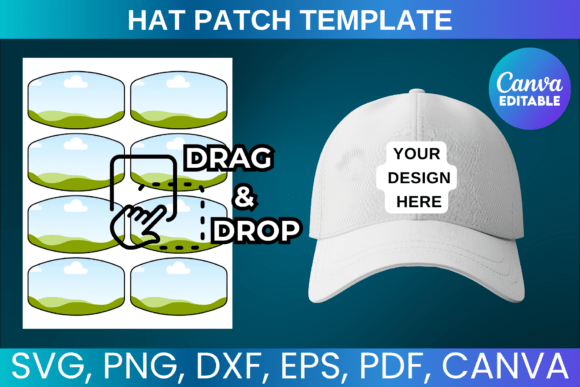
Hat Patch Template Graphics for Canva
As a brand designer who’s built visual identities for over 30 local businesses—from maple syrup makers in Vermont to ceramic studios in Austin—I opened the Hat Patch Template, Fabric Ironing Patch expecting a simple decorative element. Instead, I found a surprisingly versatile graphic design asset with quiet confidence: clean vector outlines, generous negative space, and subtle texture cues that suggest fabric grain—not just flat illustration. It reads as handmade but intentional, playful but grounded, and rustic without leaning into cliché. That balance makes it ideal for small business branding where authenticity matters more than polish.
A Real-World Fit: The “Maple & Mirth” Bakery Launch
I recently used the Hat Patch Template, Fabric Ironing Patch to develop packaging and promotional visuals for Maple & Mirth, a family-run bakery launching seasonal maple-cinnamon scones. Their brand voice is warm, nostalgic, and locally rooted—no sterile minimalism, no forced whimsy. This template landed perfectly: its rounded corners and soft edge treatment echoed hand-stitched burlap bags, while its scalable SVG structure let me resize it cleanly for everything from 1.5-inch hang tags to 24-inch farmers’ market banners.
Where It Strengthens Local Business Branding
The Hat Patch Template, Fabric Ironing Patch isn’t just decoration—it’s a functional tool for building cohesive brand identity. Used thoughtfully, it supports:
- Stronger first impression: Applied as a foil-stamped accent on kraft paper bakery boxes, it signals care before the box is even opened.
- Better product recognition: Repeated as a subtle watermark on social media graphics, it builds visual rhythm across Instagram posts, email headers, and printed flyers.
- Clearer visual hierarchy: When layered behind a bold serif logo on a menu board, it adds depth without competing—guiding the eye where it needs to go.
- More consistent brand identity: Its vector nature ensures pixel-perfect scaling across product labels, thank-you cards, and reusable tote bag prints.
- Improved customer trust: On handmade soap labels or candle jars, it subtly reinforces “crafted locally”—not mass-produced.
Best Uses for Real Small Business Projects
This graphic design asset shines brightest where tactile warmth meets practical visibility. For local business owners, it works exceptionally well in:
- Product labels and packaging accents: As a die-cut window frame on compostable pouches, or a debossed-style element on rigid soap boxes.
- Hero graphics and decorative brand elements: Enlarged and softened with a feathered mask for website banners or café wall decals.
- Seasonal packaging and boutique visuals: Paired with autumnal color palettes for harvest-themed goods, or simplified with gold foil for holiday gift sets.
- Social media campaign graphics: Animated gently in Canva as a “stitching-in” reveal for new product launches.
- Printable inserts and thank-you cards: Printed on textured cotton paper for an elevated unboxing moment.
Where to Use It Carefully
Even strong design assets have limits—and misusing the Hat Patch Template, Fabric Ironing Patch can dilute impact. Avoid placing it:
- In formal corporate branding contexts (e.g., law firm letterhead or medical device packaging).
- On very small labels (<1 inch) without testing legibility—its organic edges soften at tiny sizes.
- Over ingredient-heavy layouts where clarity trumps charm (think USDA-certified food labels).
- Against low-contrast backgrounds (e.g., light gray on off-white), where transparency edges may blur.
- In luxury minimalist brands where every element must serve absolute restraint—here, it reads too “textured.”
Practical Brand Designer Notes You’ll Actually Use
Before committing this Hat Patch Template, Fabric Ironing Patch to your next client project or product line, run these checks:
- Test it on real packaging mockups—not just digital previews—to see how it interacts with material texture and lighting.
- Check black-and-white usage: Does it retain shape and hierarchy when converted to monochrome for cost-effective printing?
- Preview it on small labels at actual print size—vector doesn’t guarantee readability if details vanish at scale.
- Test it with your brand colors: Does it harmonize with earthy tones? Pop against pastels? Fade beside muted neons?
- Compare it side-by-side with competitor packaging—does it stand out *meaningfully*, not just decoratively?
- Review PNG transparency: Are edges crisp? Is there unwanted haloing around the SVG outline?
- Confirm commercial licensing—this is non-negotiable for physical product sales or client work.
- Test typography pairings: Does it hold up beside a sturdy serif (like Playfair Display), a friendly sans (like Inter), or a delicate script (like Pacifico)?
Why This Matters for Handmade Businesses and Local Brands
For a handmade soap maker in Portland or a children’s book illustrator in Nashville, the Hat Patch Template, Fabric Ironing Patch isn’t just another Canva template—it’s a shortcut to visual cohesion. It bridges digital design and physical craft: its SVG foundation supports precise laser cutting for leather patches; its PNG variants drop cleanly into social media ads; its sublimation-ready structure lets screen printers adapt it for aprons or tote bags. When used as part of a thoughtful brand identity system—not as a standalone flourish—it elevates packaging design, strengthens product label storytelling, and deepens emotional connection through consistent, tactile-feeling visuals.
That’s the quiet power of a well-chosen graphic design asset: it doesn’t shout. It settles in. It feels like homegrown—not outsourced. And for local business owners building something real, that’s worth more than any trend.