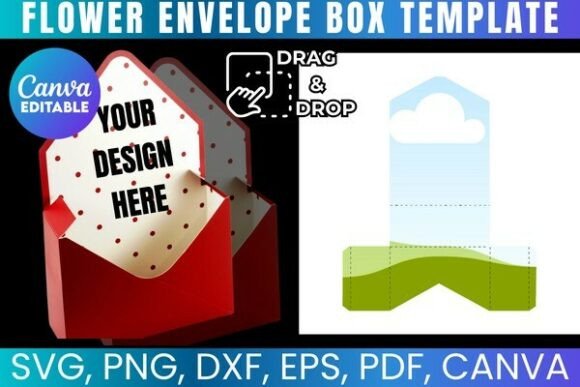
Flower Envelope Box Template: Canva Graphics for Local Branding
As a brand designer who’s developed visual identities for over 30 local businesses—from artisanal candle studios in Portland to family-run bakeries in Austin—I recently evaluated the Flower Envelope Box Template for a real client project: a seasonal lavender honey line launching at farmers’ markets and boutique gift shops. My goal wasn’t just to “make it pretty”—it was to assess whether this graphic design asset could meaningfully strengthen their brand identity, packaging design, and customer perception—without requiring custom illustration or hours of Canva tweaking.
A First Impression That Speaks Before the Product Does
The Flower Envelope Box Template opens with soft watercolor-style blossoms, delicate stems, and gentle negative space—no heavy outlines or saturated gradients. It feels intentionally organic, handmade, and quietly elegant. Not overly feminine, not aggressively rustic—but warm, approachable, and grounded. For small business branding, that’s gold. It suggests care, authenticity, and attention to detail—qualities customers instinctively trust in local food businesses, skincare brands, and handmade sellers. It doesn’t scream “luxury minimalist,” nor does it lean into playful cartoonishness. Instead, it occupies that sweet spot where premium meets personal—a mood that aligns perfectly with farm-to-table coffee roasters, botanical soap makers, and children’s product brands seeking gentle sophistication.
Where This Graphic Design Asset Earns Its Keep
In practice, the Flower Envelope Box Template goes far beyond its name. Yes, it works beautifully as an envelope box template—but its real value lies in versatility across touchpoints:
- Packaging accents: Use the floral motif as a border on product labels, hang tags, or sticker seals—especially effective on kraft paper or matte white stock.
- Printable inserts: Scale down the pattern for thank-you cards tucked inside orders, reinforcing brand warmth post-purchase.
- Social media graphics: Extract individual blooms to build cohesive Instagram story templates or seasonal campaign banners (think “Spring Collection Launch” or “Holiday Gift Boxes”).
- Menu & price list design: Layer subtle versions behind clean typography for café menus or boutique price tags—adding texture without sacrificing readability.
- Product mockups: Drop the template into realistic box mockups (like flat-lay gift boxes or shelf-ready displays) to test shelf appeal before printing.
This isn’t just decoration—it’s functional brand reinforcement. Every use strengthens visual hierarchy, deepens emotional connection, and signals consistency across physical and digital spaces. For a local business owner juggling baking, bookkeeping, and Instagram posts, having one editable, cohesive graphic design asset cuts production time while elevating perceived professionalism.
Where to Lean In—and Where to Pause
The Flower Envelope Box Template shines brightest when supporting—not overshadowing—core brand elements. It excels in:
- Hero graphics for website banners or email headers
- Decorative brand elements on packaging flaps, ribbon wraps, or tissue paper overlays
- Seasonal campaign visuals (e.g., spring florals for a garden-themed candle line)
- Boutique visuals like window clings, shelf talkers, or gift receipt borders
But proceed thoughtfully in these contexts:
- Formal corporate branding: Its organic softness may clash with law firms, financial advisors, or B2B tech services.
- Very small labels: Fine petal details can blur or disappear below 1.5” width—always preview scaled-down PNG exports.
- Ingredient-heavy layouts: Don’t place dense text blocks directly over busy areas—use simplified versions or crop strategically.
- Luxury minimalist brands: If your brand relies on stark contrast and monochrome restraint, this template’s warmth may dilute your positioning.
Practical Designer Notes You’ll Actually Use
Before committing to the Flower Envelope Box Template for client work or your own small business branding, run these checks:
- Test on real packaging mockups—not just Canva previews—to see how scale, color, and texture translate to physical materials.
- Check black-and-white usage: Print a grayscale version to confirm contrast holds up for accessibility and ink-saving label runs.
- Preview with your brand fonts: Try pairing the floral motif beside serif (e.g., Playfair Display), sans serif (e.g., Inter), script (e.g., Pacifico), and handwritten styles—note where hierarchy stays clear.
- Verify commercial licensing: Confirm the Canva Box Template includes full commercial rights for physical product sales, not just social media use.
- Inspect transparency and vector options: If you need crisp resizing or layered editing, check whether the download includes SVG or high-res transparent PNGs—not just flattened JPEGs.
- Compare against competitor packaging: Does it help your product stand out on crowded shelves—or blend in?
For handmade businesses and local brand owners, this kind of due diligence separates polished marketing visuals from forgettable decoration. The Flower Envelope Box Template isn’t a shortcut—it’s a strategic tool. Used intentionally, it supports stronger first impressions, better product recognition, and more consistent brand identity across every customer touchpoint.
Final Thought: Design Assets Are Business Tools
When I presented three packaging concepts to my lavender honey client—including one built around the Flower Envelope Box Template—they chose the version that felt most “like us”: grounded, thoughtful, and quietly special. That’s the power of a well-chosen graphic design asset. It doesn’t replace strategy or storytelling—it amplifies them. For small business branding, especially in competitive local markets, that amplification is often the difference between being seen… and being remembered.