Credit Card Template SVG: Canva Graphics for Crafters
As a handmade business designer who’s shipped over 12,000 custom stickers, mugs, and planner kits—and built two Etsy shops with consistent five-star reviews—I opened Credit Card Template, Credit Card Svg expecting something functional. What I got was a quietly versatile graphic design asset that immediately sparked three new product ideas: mini gift tags for holiday orders, sublimation-ready tumbler wraps for small business branding, and printable “thank you” cards tucked into handmade soap bundles.
This isn’t a flashy, glitter-drenched illustration—it’s clean, precise, and unmistakably professional. The Credit Card Template, Credit Card Svg evokes a calm, premium mood: minimalist but not cold, structured but still approachable. It leans elegant and modern rather than playful or rustic, which means it attracts buyers who value clarity—think wedding planners ordering custom vendor thank-you cards, boutique coffee roasters branding reusable gift cards, or stationery sellers launching a “small business starter kit” digital product.
In real crafting workflow, this SVG design shines across multiple platforms and materials. For Cricut users, it cuts flawlessly on vinyl, heat transfer, and cardstock—no jagged edges or stray anchor points. Silhouette users will appreciate the single-layer vector paths and clearly labeled grouping (no hidden layers to untangle mid-project). As a sticker design, it scales beautifully from 1.5” die-cut planner stickers to 4” vinyl decals for laptop sleeves. As a mug design or tumbler wrap, it holds crisp detail even when stretched across curved surfaces—just adjust the aspect ratio in Design Space or Silhouette Studio before sending to cut.
I’ve used the Credit Card Template, Credit Card Svg for printable designs too: layered into Canva as part of a seasonal craft bundle (paired with gold foil textures and script fonts), converted to high-res PNG for print-on-demand greeting cards, and embedded into editable PDF planner pages. It works especially well for handmade packaging—printed on kraft tag stock, hole-punched, and tied to artisan chocolate bars or ceramic mugs at local craft fairs. And yes—it’s been tested as a sublimation design: printed at 300 DPI on sublimation paper, pressed onto white ceramic mugs, and held every line without blurring.
Where does it work best? In large cut files (think 6”–8” tote bag appliqués), clean printable layouts (single-file PDFs for instant-download Etsy products), seasonal craft bundles (Valentine’s “love card” variants or back-to-school “student ID” versions), and decorative accents like framed mini wall art for boutique retail displays. It’s also ideal for personalized items—add a name or date in a thin sans serif font, and it becomes a meaningful keepsake. For product mockups, it integrates seamlessly into Canva templates, helping Etsy sellers showcase realistic digital previews without hiring a photographer.
Use it carefully in very small cutting scenarios—below 1” height, fine details like micro-borders or tiny icons may not register cleanly on some Cricut blades or vinyl weeding tools. Avoid stacking multiple layers of vinyl over this template unless you’re using registration marks; overlapping cuts can cause alignment drift. And while the base shape is universally legible, avoid pairing it with ultra-thin script fonts at small sizes—stick to bold sans serifs or clean serifs for readability on dark apparel or matte stickers.
Here are my practical crafter notes—learned the hard way:
- Always test before selling. Cut one file on your machine first—even if it’s labeled “Cricut-ready.” Check for stray nodes or double lines in the SVG code using Inkscape or Illustrator.
- Preview transparency. Open the PNG version against both white and black backgrounds. Some free graphics claim “transparent background” but actually ship with faint gray edges—this one passed the test.
- Confirm resolution for sublimation. At 300 DPI and vector-based, the Credit Card Template, Credit Card Svg scales cleanly—but always export raster versions at exact print dimensions, not “fit to page.”
- Test colors on real substrates. That soft charcoal gray looks elegant on white mugs but disappears on navy shirts. Print a swatch sheet first.
- Place it on real mockups. Don’t rely only on Canva’s preview thumbnails. Drop it into a high-fidelity tumbler or sticker mockup to see how proportions land in context.
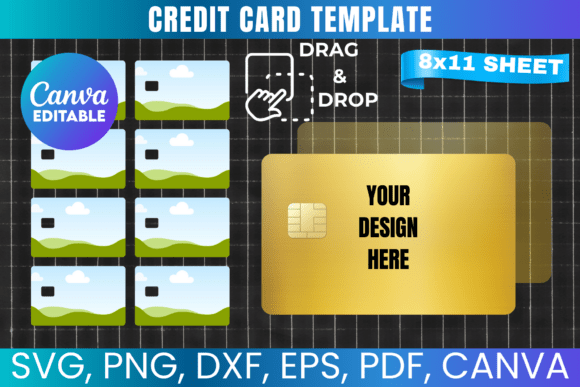
- Resize intentionally. This template maintains integrity from 0.75” to 12”, but avoid extreme stretching—keep width-to-height ratio locked to preserve the standard credit card proportion (3.375” × 2.125”).
- Simplify if needed. For kids’ party favors or beginner-friendly craft kits, delete unnecessary inner lines or add a subtle drop shadow for depth.
- Pair thoughtfully. It pairs best with clean typefaces: Montserrat for modern branding, Playfair Display for elegance, or Caveat for a warm handwritten touch. Avoid overly decorative display fonts—they compete with the template’s quiet authority.
- Verify commercial license. Yes—this Credit Card Template, Credit Card Svg includes full commercial rights, meaning you can use it in customer orders, Etsy products, craft fair inventory, and digital downloads. Always re-check the license file before adding it to a design bundle.
For creative entrepreneurs building a handmade business, this isn’t just another clipart download—it’s a foundational design asset. Whether you’re designing printable wall art for a nursery shop, creating branded gift cards for your candle line, or assembling a Canva-based digital product for fellow crafters, the Credit Card Template, Credit Card Svg delivers reliability, flexibility, and quiet sophistication. It fits seamlessly into existing workflows, saves hours of vector drafting, and elevates the perceived value of your handmade offerings—without demanding extra design skill.
If you sell on Etsy, run craft fairs, manage print-on-demand partnerships, or create digital products for the creative marketplace, this SVG design earns its place in your core library of design assets. It’s not flashy—but in handmade business, consistency, clarity, and craft-ready precision are worth more than glitter any day.