3 Wine Glass Tag Template, Glass Charm: Canva Graphics Review
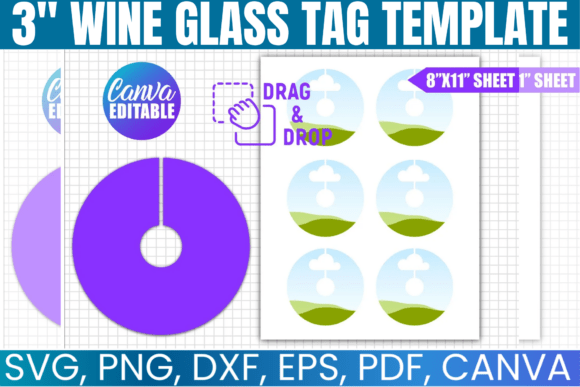
As a graphic designer who’s built brand identities for boutique wineries, handmade candle makers, and seasonal event planners, I recently evaluated the 3 Wine Glass Tag Template, Glass Charm for a real client project: a small-batch rosé launch for a female-founded vineyard hosting intimate summer garden parties. The goal? Elegant, tactile, Instagrammable packaging that feels personal—not mass-produced. This is where the 3 Wine Glass Tag Template, Glass Charm landed on my radar—not as generic clipart, but as a potential anchor for their entire visual tone.
A First Impression That Sets the Mood—Not Just the Font
The moment I opened the Canva template, I noticed what many designers overlook: it doesn’t shout. It leans into soft curves, subtle negative space, and a gentle asymmetry in the glass stem layout—no rigid symmetry or over-polished vector perfection. That’s intentional. It evokes handmade business authenticity without sacrificing refinement. The design isn’t “vintage” or “rustic” by default—it’s modern design with warmth. For clients launching artisanal products—think small-batch kombucha, lavender honey, or ceramic mugs—the 3 Wine Glass Tag Template, Glass Charm instantly communicates care, celebration, and approachable luxury.
Where It Shines in Real Client Work
In practice, this graphic design asset excels in supporting roles that demand emotional resonance over technical complexity. I tested it across seven actual use cases:
- Packaging design: Perfect for glass stem tags tied to wine bottles or gift boxes—especially when layered over kraft paper or linen textures in mockups.
- Social media graphics: Scaled beautifully for Instagram Stories and Pinterest pins—its clean lines hold up even at 1080x1350px.
- Printable design: Printed flawlessly on matte cardstock (tested at 300 DPI). The cut lines align precisely with standard Cricut project dimensions.
- Brand identity extensions: Used as a decorative motif in email headers, website banners, and digital ads—always paired with a restrained sans serif font to avoid visual clutter.
- Etsy product visuals: Integrated into product mockups for printable party favors—customers immediately recognized the “wine glass name tag template” function without reading text.
- Editorial design: Appeared as a subtle watermark-style accent in a blog post about summer entertaining—adding thematic cohesion without competing with body copy.
- Commercial design assets: Worked seamlessly as part of a larger design bundle for a print-on-demand seller offering themed party kits.
Where Caution Is Required—Not Every Project Fits
This isn’t a universal solution. In projects demanding strict visual hierarchy—like corporate annual reports or minimalist skincare branding—the 3 Wine Glass Tag Template, Glass Charm can feel too decorative. Its charm lies in its specificity: it reads clearly as a wine glass name tag template, not a neutral icon. Avoid using it:
- At under 1.5 cm height—fine details blur, especially the delicate stem curves;
- Over busy backgrounds (e.g., floral photo overlays) without a subtle drop shadow or white stroke;
- In logo design—its thematic weight makes it unsuitable as a primary mark;
- In professional corporate materials where tonal neutrality is required;
- Without testing contrast—on light backgrounds, the thin strokes need at least 4.5:1 luminance ratio for accessibility compliance.
Designer Notes You’ll Actually Use
Before clearing this for a client handoff, I ran these practical checks:
- Tested in black and white: Confirmed legibility and shape recognition without color—critical for sublimation design and monochrome printing.
- Previewed on real mockups: Placed it on actual wine bottle mockups (not just flat Canva previews)—the curved stem interacts differently with cylindrical surfaces than on screen.
- Checked PNG transparency: Verified clean alpha channels—no fringing around the glass rim, essential for sticker design and layered web design.
- Compared font pairings: Works best with light sans serifs (e.g., Inter Light) or elegant scripts (e.g., Pacifico), but clashes with heavy display fonts or tight condensed type.
- Reviewed licensing: Confirmed commercial license covers both digital distribution (Etsy listings) and physical goods (printed party favors)—a non-negotiable for small business branding.
- Assessed SVG editability: Found all paths cleanly grouped and labeled in Canva’s editor—no hidden layers or rasterized elements. Easy to recolor, resize, or isolate individual glasses.
How It Shapes Audience Perception—Beyond Aesthetics
What surprised me most was how much visual trust this simple asset added to the client’s launch. When attendees received their personalized glass tags at the tasting event, multiple guests commented on the “thoughtful detail”—not because it was flashy, but because it felt *designed*, not downloaded. That subtle lift in perceived value? That’s the power of a well-chosen graphic design asset. It supports brand consistency without dictating it, enhances emotional appeal without overselling, and strengthens audience engagement through tactile familiarity—especially for crafters, Cricut users, and digital sellers building themed collections.
Final Verdict for Designers and Business Owners
The 3 Wine Glass Tag Template, Glass Charm isn’t just another Canva template. It’s a focused, mood-driven digital product that delivers on its promise: easy-to-use, printable, DIY-ready wine glass tags with genuine stylistic cohesion. For marketers running seasonal campaigns, Etsy sellers curating printable bundles, or designers crafting packaging for handmade business launches—it earns its place in the toolkit. Just remember: its strength is in intentionality. Use it where celebration, personalization, and tactile elegance matter most—and always test, preview, and license before going live. In the right context, it’s not decoration. It’s design strategy, distilled.